 US Entrance
 Canadian Entrance
The International Peace Garden on the US-Canadian border serves as a living symbol of the friendship between the two countries that share the longest unfortified border in the world. The concept for the garden was conceived in 1928 by Dr. Henry Moore, a Canadian horticulturalist associated with London’s famous Kew Gardens. Its location on the Manitoba-North Dakota border was chosen for its proximity to the geographical center of North America.
To finance this project, a major promotional campaign was launched through newspapers, radio, and public speeches to encourage small monetary donations from as many individuals as possible, especially school children, rather than large donations from only a few. The intent was to make the Peace Garden a “peoples’ garden.” The strategy was to raise the money by having every pre school aged child in the United States and Canada give five cents, every school aged child give ten cents and every adult a minimum of twenty-five cents.
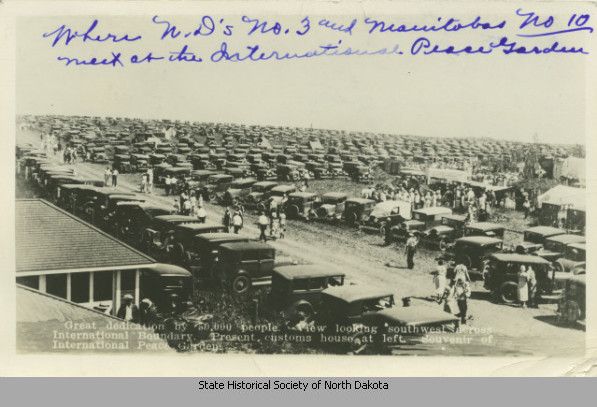
Manitoba donated 1,451 acres of wilderness and North Dakota donated 888 acres of agricultural land for a total area of 2,339 acres. Enthusiasm for the creation of the Garden was evident with over 50,000 people attending the dedication ceremony on July 14, 1932. The attendance rate was impressive considering that traveling at that time meant driving over rough and unimproved local roads. President Herbert C. Hoover of the United States, as well as the Canadian Governor-General, Lord Bessborough, and Prime Minister, the Honorable R. B. Bennett, sent congratulatory messages to the dedication ceremony.